New AIA article about David Osler

New AIA article about David Osler

The Huron Valley chapter of the American Institute of Architects (AIA) just sent out a new publication to their members that celebrates the accomplishments of local architects. Of particular interest is an article written by one of their members, Martin Schwartz, which contains some great insights into David Osler’s career and accomplishments.

a2modern would like to thank Brad Angelini, President of the AIAHV, for giving  permission to reproduce this publication on our website.

You can read the article here on pages 6 – 27.

Mies van der Rohe’s Lafayette Park

Sold Out

Time: 1:00-3:00 p.m.
When: Saturday, September 9th, 2017
Cost: $30/person, registration required

Detroit’s Mies van der Rohe Historic District in Lafayette Park includes 186 cooperatively owned Town House and Court House units, three apartment towers, an elementary school, a retail district, and a 13-acre park known as the Lafayette Plaisance.

The neighborhood has been hailed as “one of the most spatially successful and socially significant statements in urban renewal” and as a “prototype for future urban development predicated on human values.” The site contains the largest collection of buildings by the architect Mies van der Rohe in the world, as well as the only group of row houses built to his specifications.

The tour will be conducted by Christian Unverzagt and Neil McEachern, both long-time residents of Lafayette Park. Unverzagt is an Assistant Professor of Practice in Architecture at the University of Michigan’s Taubman College. McEachern, now retired, is a former Detroit Public Schools principal.

Space is limited (only 12 tickets available), REGISTER HERE

LOGISTICS: Transportation is on your own. We will meet at the Mies van der Rohe Plaza in the Shops at Lafayette Park at 12:45 p.m. Parking is available in the shops (off Lafayette). Alternatively, public parking is available on Joliet Place and Nicolet Place (off Rivard) and the plaza may be approached from the north by walking through the Plaisance.

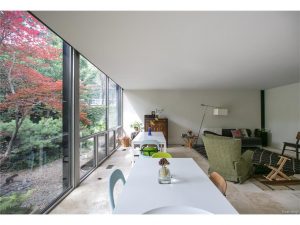
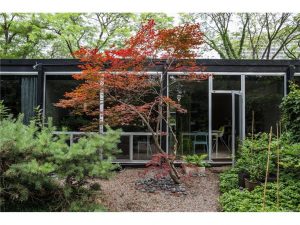
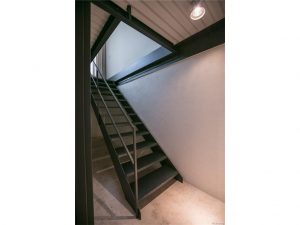
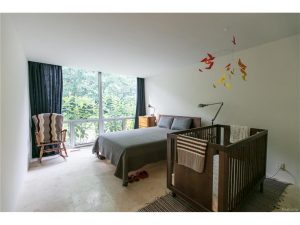
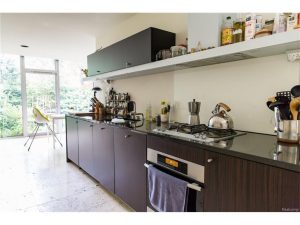
Below are pictures of a courtyard unit at 1320 Nicolet Pl. that is currently for sale.

lafayette1lafayette2lafayette3lafayette6lafayette5lafayette4

Regent Drive and Highland Road Walking Tour – 8/17

On Thursday, August 17, at 6:30 P. M., Grace Shackman will lead a walking tour of Highland Road and Regent Drive. The lots on both streets were sold with the caveat that the homes be architect-designed. Architects represented include George Brigham, David Osler, Robert Metcalf, and Aldon Dow.

Tickets are $10 and can be purchased here. The tour will be limited to 20 people. Meet at the corner of Regent Drive and Highland Road, which is north of Geddes Road near the Arboretum.

The Unitarians’ Creative Reuse of 1917 Washtenaw

Author: Grace Shackman

Even Frank Lloyd Wright approved.

Most church groups that need to relocate either buy a church building abandoned by another congregation or build a new church. But in 1946, when the Ann Arbor Unitarian Universalists left their handsome stone church at the corner of State and Huron, they moved to a house on Washtenaw.

According to the church’s current minister, Ken Phifer, using houses is not uncommon among Unitarian congregations; he could name five other examples immediately. “The Unitarians don’t worry about following any architectural standard,” he says. “Every building and every community is different.” He links this to the Unitarian belief that “individuals follow their own path.”

The Unitarians bought the house at 1917 Washtenaw from Dr. Dean Myers, a prominent eye, ear, nose, and throat specialist. Built in 1917 (by coincidence, the year matches its address on Washtenaw), the Swiss chalet-style house was one of the most elegant on a street of distinctive homes. It was well built of sturdy fieldstone and was the pride of its builders, Weinberg and Kurtz. (For years, a picture of the house was featured on the construction firm’s checks.)

The front entry area was flanked by a formal living room on the west and a library and dining room on the east. Sun rooms on each side were entered through French doors. Next to the dining room was the butler’s pantry and beyond that the kitchen and cook’s pantry. The bedrooms on the second floor had adjacent sleeping porches over the sun rooms. On the third floor were luxurious guest quarters and a maid’s apartment with sitting room and bathroom. In the basement, besides the usual storerooms and laundry room, there was a billiard room with wooden pillars and a fireplace.

Myers, who was widowed when the house was built, moved in with his daughter, Dorothy, and his mother-in-law, Mrs. Owens. He was then forty-three years old and at the peak of his career as an innovative eye surgeon. He was also active in community affairs, serving on city council and the school board and as chair of the county Democratic party. An avid golfer, Myers helped lay out the first nine holes of the Barton Hills golf course and was the first player to make a hole-in-one there.

For the first six years in the house, Myers got by with day help, but in 1923, when he married Eleanor Sheldon, the housekeeper at Betsy Barbour, he decided it would be better to have a live-in maid. On the recommendation of friends, he sponsored a seventeen-year-old immigrant girl from Swabia in southern Germany. Carolina Schumacher (she married Gottlob Schumacher in 1930) cooked, washed, and ironed for the family.

Mrs. Schumacher still remembers her first day. She had to enter through the back door because Washtenaw was being paved and was covered with straw. She remembers Dr. Myers as “nice looking, tall and bald headed, always smiling.” (He used to say, she recalls, that “you can’t have brains and hair too.”)

The house was grandly furnished, with oriental rugs throughout and a grand piano in the living room. Before dinner, Myers liked to sing, accompanied by Dorothy at the piano. The Myerses entertained frequently, often other well-known local doctors, like Albert Furstenberg and R. Bishop Canfield, and sometimes visiting out-of-town doctors.

Mrs. Schumacher left the Myerses’ employ when she and her husband started the Old German restaurant. After Mrs. Owens’s death and Dorothy’s decision to move in with a friend, Dr. and Mrs. Myers stayed in the big house until 1946, when they moved to Hildene Manor, the gracious Tudor-style apartment building at 2220 Washtenaw. Dr. Myers died in 1955 and his wife a few years later.

The Ann Arbor Unitarians had been in their church at State and Huron since 1883, and the decision to move was a difficult one. Parishioners–including the children of Jabez Sunderland, the minister under whom the church had been built–realized the historic value of the old building, both architecturally and as a repository of memories. But it had deteriorated, inside and out, and the costs of repair far exceeded the church’s resources. The Depression and then World War II had depleted the membership; when Ed Redman took over the ministry in 1943, there were sixteen contributing member families.

Don Campbell, then the church treasurer, says that the old church “was like a barn–cold, hard to heat, dirty.” Services were held in the library, which was easier to heat, because it was rare for more than thirty-five people to show up.

Ironically, it was Redman’s success in bringing the membership back up that sounded the death knell for the old church. He attracted young families, many with children, and soon the church could not provide the needed Sunday School space, even spreading out to the parsonage next door on State Street. When, in 1945, the Grace Bible Church offered the Unitarians $65,000 for the old building, they accepted the offer and began to search in earnest for a new home. The following year they bought the Myers house for $46,000.

On February 3, 1946, Redman gave his last sermon in the old church. It was entitled “Sixty-Four Glorious Years.” After a few months in Lane Hall, he delivered the premiere sermon in the Myerses’ former living room, calling it “Birth of a New Age.” The house took on an entirely new identity. Church social events were held in the old dining room, while the Sunday School met in the second- and third-floor bedrooms.

The Redmans had planned to live in a parsonage on Packard, but they found the house too small (Redman and his wife, Annette, had five children) and preferred to live closer to the action. A parsonage addition was built at the back of the house, one floor in 1948 and a second in 1955. By the fall of 1951, it was obvious that the church was outgrowing its house. Redman, in his recollections published by the church in 1988, wrote, “The worship services could not be contained in the original living room space of the chalet. John Shepard had installed storm windows in the side porch, and it was quite fully occupied except in the most severe weather. The entry hallway provided additional seating space extending all the way into the original sun room. And the main stairway was also often occupied!”

The church began collecting money for an addition, receiving pledges for $40,000. George Brigham, a prominent architect on the U-M faculty and a church member, was hired to design the addition with an auditorium upstairs and a social hall and kitchen downstairs.

According to Redman’s memoir, Brigham’s charge was “safeguarding the architectural integrity of the existing chalet and the design of additions, which would pick up on the theme of the chalet to create a total facility blending in a unified way with its landscape.” Redman continues proudly: “That the goal was substantially achieved by Professor Brigham was attested when the renowned Unitarian architectural master Frank Lloyd Wright expressed one of his rare approvals by exclaiming, ‘That’s good!’ ”

Today the church stands as completed in 1956, except for a change in the roof line to make the building easier to heat. The section that was the Myers house is used for offices: dining room for main office, master bedroom for minister’s study, Mrs. Owens’s bedroom for the religious education director’s office. The sun room off the living room is the library. The National Organization for Women rents an office on the second floor, and the old parsonage is often rented during the week by preschool groups. The carriage house where the Schumachers lived is now home to a Salvadoran refugee family sponsored by the church.

The Unitarian Universalist church continues to thrive in the space, with a membership of 416, not counting children. Phifer, who fell in love with the building the moment he saw it, says, “I never heard anyone say anything but praiseworthy about it.”

Grace Bible eventually outgrew the old church at State and Huron, moving to an ambitious new complex on South Maple Road. The building sat vacant and deteriorating for several years until it was finally restored as the offices of Hobbs and Black architects. It was an ideal solution: Hobbs and Black got a showpiece office, and the building a proud, well-heeled tenant. “It’s beautiful, but it cost an arm and a leg,” Don Campbell says of the restoration. “The church didn’t have that kind of money.”

[Photo caption from original print edition]: The Unitarians’ additions have been so subtly done that today’s expansive church (above) looks surprisingly unaltered from its days as a private home (right).

The Three Lives of 1830 Washtenaw

Author: Grace Shackman

The stately and prestigious Women’s City Club started as a simple farmhouse.

In its 100-plus years, 1830 Washtenaw has changed in harmony with the street it faces. Built when Washtenaw was a dirt country road, it was first a simple, boxy farmhouse. When Washtenaw became a fashionable address, the house was ingeniously transformed into an imposing home for a wealthy physician. As the Women’s City Club since 1951, it has continued to evolve, expanding physically and adapting socially as it moves to encompass the needs of career women as well as club women. It provides meeting space for seventeen member clubs and 900 individual members, to whom its dining room, lounges, and library are an ideal place to hang out, entertain guests, or, in the case of the increasing number of professional women members, meet with clients.

cityclubsignThe house was built by Evart Scott, who moved to Ann Arbor from Ohio in 1868 to attend the U-M. Scott completed only two years of college, but stayed in town to become a successful businessman, civic activist, and farmer. He was president of the Ann Arbor Agricultural Co., which ran a mill at Argo dam, and a member of the school board, the public works board, and the board of Forest Hills Cemetery.
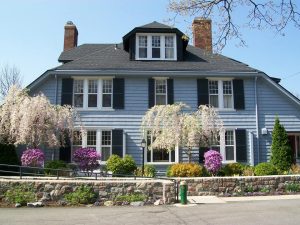
Scott moved into the house on Washtenaw in 1886, a few years after starting an orchard and nursery on what was then a thirty-acre plot just outside the city limits. He planted elm trees along his 1,000-foot Washtenaw frontage (from present-day Ferdon all the way to Austin) and named it “Elm Fruit Farm.”

In 1915, after the city had annexed the area, Scott sold the bulk of his farmland to Charles Spooner. Spooner subdivided it into building lots and, in collaboration with architect Fiske Kimball, built the elegant homes that still grace the neighborhood. Reminders of the land’s earlier owner can be found in the street names Scottwood and Austin (the name of Scott’s father, brother, and son) and in a few ancient fruit trees, most of them pear, found in the neighborhood.

Two years after selling the land, Scott moved to a smaller house at 1930 Washtenaw, on the eastern edge of his property. He sold the big house and three acres of land to Dr. R. Bishop Canfield, a professor in the medical school who was returning to town after wartime duty in the U.S. Medical Corps.

Canfield hired architect Lewis J. Boynton to turn the forty-year-old farmhouse into something more suitable for its increasingly prestigious address. Boynton succeeded in cityclubfrontview2transforming the simple box into an impressive house in the then fashionable Dutch colonial revival style. He replaced the old-fashioned wraparound porch with small extensions on each end of the house. Then he added a massive sloping roof that came down over the porches and allowed the attic windows to peek through as dormers. The finishing touch was a delicate front entrance porch with slender Ionic columns.
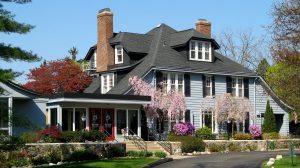
Canfield was one of the nation’s leading specialists in ear, nose, and throat problems. He and his wife, Leila, a nurse from Colorado, had one child, a redheaded adopted daughter, Barbara. Alva Sink, a longtime member of the Women’s City Club, knew the Canfield family well. For three of the years that she was a student at the U-M in the early 1920’s, she ran a private school on their third floor, teaching Barbara and five other children of prominent families, including Jane Burton, daughter of the U-M president. Mrs. Sink remembers the Canfield house as “beautiful,” and says that the interior “looked much as it does today.” She recalls that Mrs. Canfield’s help included a cook, maid, and yardman.

Canfield died in 1932, at age fifty-eight, when his car ran into a tree near the present site of Arborland. He was returning home after driving his wife and daughter and Dr. and Mrs. A. C. Furstenberg (he would later become dean of the medical school) to Detroit to catch a train to New York, where all but Mrs. Canfield were to sail for Europe. Mrs. Canfield hurried home as soon as she received news of her husband’s death. Unfortunately, the Furstenbergs and Barbara had already sailed. Informed by ship’s radio, they could do nothing but sail on to Gilbraltar, where they boarded a ship returning to the U.S.

Mrs. Canfield continued to live in the house until her death almost twenty years later. When the house went on the market in 1950, a group of local women were looking for a location for a women’s club. Up to then, many groups had met on campus, especially in the Women’s League, but increased enrollment at the U-M after World War II made university space harder to obtain.

By then, too, Washtenaw’s big houses weren’t quite so desirable as they’d been: few postwar families could afford servants to care for rambling buildings and grounds, and the street’s increasingly heavy traffic was a worry for children. (Washtenaw at that time was part of Route 23, which went through town.) To the chagrin of residents, some houses were being taken over by fraternities, sororities, and other institutional users like the First Unitarian Church, which had recently bought and remodeled a former home down the block.

There was opposition to the conversion of the Canfield home, but the proponents were capable, well-connected, and hardworking women. When critics said the house was not strong enough to hold the weight of large gatherings, member Elsie White had her husband, Dr. Albert White, head of engineering research at the U-M, arranged to have the house checked. Free financial advice was given by Earl Cress of Ann Arbor Trust, while the Roscoe Bonisteels, Sr. and Jr., donated legal advice.

The key hurdle of changing the residential zoning was solved after the group negotiated an agreement with the six nearest neighbors that they would tell the city council they had no objections to the club as long as there were no exits from the rear onto Norway.

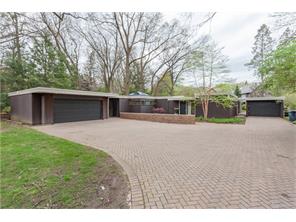
After Barbara Canfield, by then married cityclub frontviewand living in Chicago, accepted the City Club’s offer of $45,000 in January of 1951, the group went to work raising money. Margaret Towsley, secretary of the founding group, sent letters to all the women’s clubs in town asking them to join and also to encourage at least a quarter of their group to enroll as individual members. Twenty-one clubs and 600 individual members responded, and by June 20, 1951, the final papers were signed. Supplementing membership fees with fund-raising activities, the group managed to pay the entire mortgage within five years. Just six years later, architect Ralph Hammett was hired to design a modern addition to house a large dining room, auditorium, office, main lobby, and lounge.
Today, women’s clubs in many cities have lost members or completely ceased to exist due to the large number of women working outside the home. So far, the Ann Arbor club has maintained itself well. Though membership has fallen by about 200 women from its peak in 1970, the club is actively recruiting younger members with more evening programs, more events open to men, and a deferred membership payment plan for daughters of members. (The membership initiation fee is $200 and annual dues are $175.) Some of the younger members are housewives deferring careers to raise children, but many are career women – real estate agents, lawyers, and accountants. Says club archivist Ruth Whitaker, “It provides a forum for women doing volunteer work to touch base with people in the work world.” Club president Greta Smith adds, “It’s a good way to meet people if you’re new in the area.”

Most importantly, enthusiasm is still high. Elsie White describes the club as “a great blessing to the community,” while Sink says, “It’s the best thing Ann Arbor ever did for women – or rather, that they did for themselves.”

Grace Shackman Article in the Observer

If you can grab a copy of the June edition of the Ann Arbor Observer, flip to page 47 and read Grace’s article entitled “Midcentury Mail”. Learn how Kelly MacArthur is using her graphic design skills to create unique mailboxes for midcentury modern homes in Ann Arbor.

Klein Residence Open House

There will be an open house on Sunday, June 11th from 11:00 AM to 1:00 PM at 3087 Overridge Road in Ann Arbor Hills. Tickets can be purchase here.

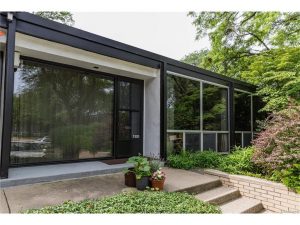
This beautiful home was designed by Edward Olencki in 1962 for the Engels and purchased by the Kleins in 1989.

Once she found herself inside this extraordinary hilltop house, Sally Klein was sure it was for her. Leaving behind their beautiful place in the country (actually Irene Olencki sold their house for them), the Kleins moved into 3087 Overridge Road in 1989. The previous owners kept the house in immaculate condition, so very little needed to be done to accommodate her family. She said that husband Tom, a mechanical engineer, took a little more time but he eventually came around to loving this Midcentury Modern masterpiece (1962) by Edward Olencki, one of three residences designed by him in Ann Arbor.

Edward Olencki came to the College of Architecture and Design at the University of Michigan in 1948, having graduated from Illinois Institute of Technology. He had worked as a draftsman and designer in the office of Mies van der Rohe in Chicago from 1943 to 1948. At Michigan he taught courses in construction materials and methods, comprehensive architectural design, and furniture design. He also ran his own architectural firm, designing homes, churches, and commercial buildings.

The Klein House on Overridge is barely visible from the street, but the ascent up the driveway instigates an Oh My Word! sense of an unfolding palace, white, somewhat austere, rising up a cliff face. The open garage leads the eye to take in the layered forms of courtyard wall, first level, second level and additional chamber farther back. And the house is sited so it’s impossible to comprehend the full scale of the house as it reaches into the surrounding ridge and trees.

Sally Klein made the comment that in the case of this house the outside is more important than the inside. She was referring to the dramatic site but once inside and having climbed the stairway to the main level, the interior dimensions convey an airy feeling of openness and light. Placed on a north south axis, three large rectangular areas accommodate sleeping quarters, living room, and kitchen dining room. On the north end a screened porch looks over a saddleback horizon into forest trees. The detailing in the house, which has remained intact (except for the removal of one bookcase to downstairs and modifications in the kitchen), employs light-toned wood surfaces and large windows. The predominately white interior with black accents adds to the serenity of these light-filled spaces.

For the walkway to the house itself, Sally traded out concrete steps for large granite stepping stones, which better complement the approach to porch area and main entrance. No description can realize how this house takes hold of the imagination. It embodies the essence of Midcentury Modern house design in its use of site, simple materials, elegant proportions and landscaped setting. This is a wonder filled house.

Robert Metcalf’s Home is for Sale

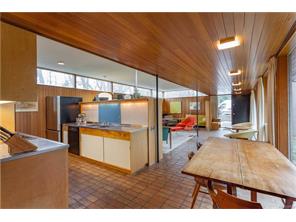
The longtime home of architect Robert C. Metcalf at 1052 Arlington, in Arbor Hills, is now for sale.

According to Gregory Saldana, Curator for a University of Michigan’s Taubman College of Architecture Exhibit in 2010 that that celebrated Metcalf’s work:

3

Bob Metcalf building his first house

“In 1952 Bob and his wife Bettie began constructing their own house on two lots in Ann Arbor at Arlington Boulevard. Both held day jobs and would meet at the job site in the afternoons. They worked along side each other in all aspects of construction including shoveling, mixing mortar, laying bricks and regularly having dinner on site. “

The Metcalf’s home served as the starting point for 68 more Metcalf-designed homes in Ann Arbor, as friends, neighbors, and colleagues  toured and visited, and were inspired by what they saw.


GetMediaGetMedia-1GetMedia-5